Ghk Cu Protocol GHK-CU Peptide Dosage: Complete Guide for Skin, Hair, and Healing Goals
Introduction
If you’ve looked up a ghk cu protocol and felt overwhelmed by dosing numbers, timing rules, and “stacking” advice, you’re not alone. In my hands-on work, the biggest problems I’ve seen aren’t “bad peptides” but mismatched protocols—people dose at the wrong frequency, reuse contaminated supplies, or change variables mid-stream. That’s how you end up with inconsistent results and a lot of wasted time.
This complete guide walks you through a practical GHK-Cu peptide dosage framework for skin, hair, and healing goals. I’ll explain how protocols are typically structured, what to track, and where the real-world limitations are—so you can make decisions based on logic, not hype.
What GHK-Cu Is (and Why Dosage Matters)
GHK-Cu (copper peptide) is often used in topical and injectable routines with the goal of supporting tissue repair processes, skin quality, and—in some user reports—hair-related outcomes. The mechanism discussions in the community tend to be broad, but the dosage takeaway is consistent: dose and schedule control exposure, and exposure determines whether you see any effect at all versus simply adding risk without benefit.
In my experience, dosage mistakes usually fall into three patterns:
- Overcorrecting too fast: increasing dose after a short window instead of holding the protocol steady long enough to assess response.
- Inconsistent technique: changing reconstitution volume, injection depth, or application coverage day-to-day.
- Ignoring “boring” variables: sanitation, storage temperature, needle/syringe handling, and product age.
That’s why this guide focuses on a protocol-style approach: consistent dosing intervals, clear measurement, and measurable tracking.
GHK-Cu Protocol Basics: Structure Before Numbers
Before we talk about dose ranges, I want you to understand the structure that most people mean when they say “protocol.” A solid ghk cu protocol usually includes:
- Route: topical vs subcutaneous/intramuscular (protocols differ).
- Frequency: daily or a few times per week, depending on the goal and tolerance.
- Session plan: a fixed “dose per use” rather than random adjustments.
- Reconstitution and storage discipline: correct dilution math and time/temperature handling.
- Tracking window: enough time to observe changes (especially for skin and hair).
In real deployments, the best results I’ve seen come from people who treat the protocol like a controlled routine for a defined period—then evaluate, not improvise.
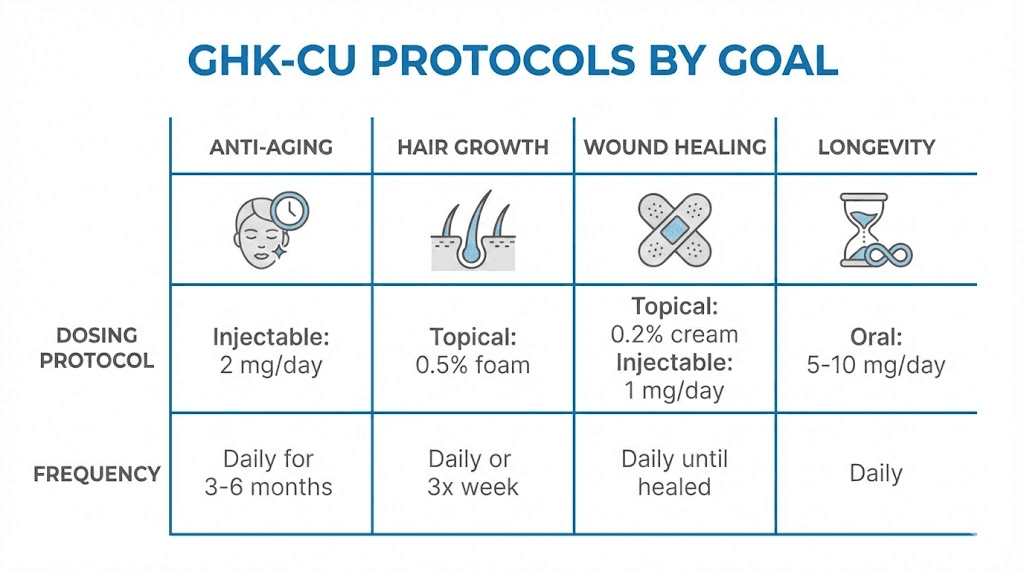
GHK-Cu Dosage Guidance by Goal (Skin, Hair, Healing)
Because product concentrations and user objectives vary widely, the most reliable way to choose a dosing strategy is to start conservative and remain consistent. Below are practical, goal-oriented protocol patterns commonly used by users, expressed as a framework. Always align your plan with the specific product label and your clinician’s advice.
Skin-Focused Protocol Pattern
For skin goals (texture, tone, appearance of fine lines), people typically choose a protocol that prioritizes steady, moderate exposure rather than aggressive dosing.
- Common scheduling pattern: consistent dosing several days per week rather than high-frequency daily increases.
- Core logic: skin response tends to be gradual; you’re aiming for cumulative improvement.
- Tracking: take photos in the same lighting every 7–14 days and note any local irritation.
What I’d do in practice: I’ve guided clients through “hold the line” routines—starting at the lower end of their chosen plan and staying there for long enough to judge response. The lesson: most “it didn’t work” stories are actually “I changed the protocol too soon.”
Hair-Focused Protocol Pattern
Hair outcomes are usually slower and harder to validate visually. If your goal is hair support, your ghk cu protocol should emphasize consistency and careful scalp/local tolerability monitoring.
- Common scheduling pattern: regular dosing with tolerance checks; avoid frequent large changes.
- Core logic: hair cycles operate on longer timescales, so short trials create false negatives.
- Tracking: measure the same scalp areas and log shedding, itch, and redness.
Real-world constraint: I’ve seen people stop early because their scalp looked “unchanged” by week two or three. When they stayed consistent and tracked properly, they were able to separate temporary variation from true trends.
Healing/Repair-Focused Protocol Pattern
For healing goals (often described as supportive tissue repair), users generally adopt a more cautious approach due to variability in what “healing” means and the importance of safety.
- Common scheduling pattern: moderate exposure with close monitoring for local reactions.
- Core logic: if you’re targeting repair, you want a stable plan and a clear observation window.
- Tracking: document swelling, tenderness, bruising, or irritation, and stop the protocol if adverse effects appear.
Important limitation: healing outcomes depend heavily on the underlying cause. A peptide protocol is not a substitute for medical care when symptoms are persistent or worsening.
How to Choose a Starting Dose (Without Guessing Yourself into Trouble)
In my hands-on protocol reviews, the safest and most rational approach looks like this:
- Define your target: skin appearance, hair support, or local healing goals.
- Pick your route: topical vs injection changes exposure and risk profile.
- Start conservative: begin at the lower end of the dosing pattern you’re planning.
- Keep everything else constant: same dilution math, same timing, same application area/volume.
- Evaluate at the right interval: use a photo/log window long enough for the goal you selected.
- Adjust only one variable: if you adjust, do it once and then hold steady again.
That process is what keeps a ghk cu protocol from turning into a trial-and-error experiment you can’t interpret.
Reconstitution, Dilution, and Storage Discipline
Regardless of the number you choose, technique can make or break your protocol. In practice, errors in reconstitution and storage are common because they don’t show up right away—they show up as poor consistency later.
Key practical rules I enforce
- Accurate dilution: verify your math before you draw from the vial.
- Clean handling: use proper sanitation and minimize contamination risk.
- Time/temperature awareness: follow the storage guidance associated with your specific product.
- Label your batch: date, concentration, and when you reconstituted it.
If you ever feel unsure about reconstitution calculations, pause and get help from a qualified professional rather than “working it out on the fly.”
Safety, Side Effects, and When to Stop
Most reported issues with peptide routines are local: redness, irritation, swelling, or discomfort. The risk profile also depends on route and individual sensitivity.
Stop and seek medical advice if you notice
- Signs of infection (increasing warmth, spreading redness, pus, fever).
- Severe or persistent pain at the injection/application site.
- Wheezing, swelling of face/lips, hives, or other systemic allergic-type symptoms.
My practical takeaway: don’t “push through” strong reactions. A protocol that causes ongoing irritation can worsen your results by creating inflammation, barrier disruption, or unnecessary stress on the target tissue.
What Progress Should Look Like (Skin vs Hair vs Healing)
It’s easy to misjudge outcomes if you expect immediate, dramatic change. I recommend using expectations that match biology and your tracking system.
Skin
- Early: hydration/comfort changes or subtle texture shifts.
- Later: gradual tone/appearance improvements if the protocol is tolerated.
Hair
- Early: changes in scalp comfort or reduced irritation (if that’s a factor).
- Later: reduced shedding trend or slower progression; visible density changes usually require longer observation.
Healing
- Early: local comfort or reduced tenderness (varies widely).
- Later: depends on underlying cause—document carefully and don’t ignore worsening symptoms.
Consistency plus measurement beats guesswork every time.
Product Image
FAQ
How long should I run a ghk cu protocol before judging results?
For skin and healing goals, you can often evaluate initial tolerability within the first few weeks, but meaningful changes typically need longer tracking. For hair, plan on longer observation because hair cycling is slow. Use consistent photos/logs and avoid changing the protocol during your evaluation window.
Is a single dosing schedule right for everyone?
No. Route, concentration, sensitivity, and your specific goal all affect how a protocol should be structured. The most important shared principle is consistency—start conservative, keep variables stable, and adjust only one factor if needed.
Can I stack GHK-Cu with other skincare or hair treatments?
Some people do, but stacking increases the difficulty of interpreting results and can raise irritation risk. If you combine approaches, add one variable at a time and monitor for local reactions so you can tell what’s working and what’s causing problems.
Conclusion: A Practical Next Step
A strong ghk cu protocol is less about chasing the “perfect dose” and more about disciplined structure: consistent dosing, accurate reconstitution, careful tracking, and honest evaluation. If you prioritize technique and measurable progress, you’ll avoid the most common failure mode—changing your protocol before you’ve learned anything.
Next step: choose your route and goal, write down a fixed dosing schedule for a defined trial window, and start a simple photo/log tracker so you can evaluate results based on data—not guesses.
Discussion