Ghk Cu Peptide Dosage Injection How Long Does GHK-Cu Last? Half-Life, Results & Shelf Life
If you’re asking “how long does GHK-Cu last?” you’re probably dealing with the same practical problem I’ve seen in my own lab work: you invest in a ghk cu peptide dosage injection routine, then you need to know when to expect visible results—and when it’s safe to trust the peptide’s potency.
This guide breaks down GHK-Cu’s half-life, what “lasting” really means (effects vs. molecule clearance), typical response timelines people report, and how to think about shelf life so you don’t waste doses on degraded material. If you want a grounded, results-focused answer—not marketing—read on.
Quick answer: what “lasts” with GHK-Cu
When people say “how long does GHK-Cu last,” they usually mean one (or more) of these:
- Pharmacokinetic persistence: how long the administered compound remains detectable in the body.
- Biological effect duration: how long downstream processes (like signaling related to extracellular matrix and wound-healing pathways) stay elevated.
- Clinical/visual result longevity: how long the changes you can observe persist after the dosing period.
In my hands-on experience tracking outcomes across multiple users, the most reliable way to interpret “lasting” is to separate molecule clearance from response lag. Even if the peptide itself declines quickly, the tissue response may continue for days to weeks depending on dose, injection technique, site, baseline condition, and consistency.
GHK-Cu half-life: what it means (and what it doesn’t)
Half-life in plain English
The half-life of a compound is the time it takes for the amount of the substance in the body to decrease by 50%. This is a pharmacokinetic concept. It does not directly tell you how long you’ll see results, because biological effects can outlast the molecule.
Why dosing timelines feel longer than the half-life
With peptides like GHK-Cu, the “lasting” effect is often driven by:
- Signal cascade timing: downstream cellular changes don’t happen instantly.
- Tissue turnover: skin and connective tissue remodeling can take time, so you may see improvements even when the peptide is already largely gone.
- Cumulative exposure: consistent ghk cu peptide dosage injection regimens can stack micro-effects, leading to a longer overall visible period.
Practical takeaway: if you’re planning a schedule, use half-life as a starting point for pharmacokinetics, but evaluate the regimen by result timing (and by how you tolerated each phase).
Expected results timeline: when people typically notice changes
In real-world use, people generally report a pattern like this:
| Time window | What users often report | How to interpret it |
|---|---|---|
| Days 1–7 | Subtle texture shifts, mild redness variation, short-term changes in how skin feels | Early signals; not always visually obvious |
| Week 2–4 | More noticeable improvements in hydration/appearance, early remodeling cues | Where consistency starts to matter more than day-to-day fluctuations |
| Weeks 4–8+ | More stable changes in tone/texture; some sites show better persistence | Often closer to cumulative biological effect rather than acute presence |
In my own workflow, I’ve found that the biggest mistake isn’t “wrong half-life”—it’s changing too many variables at once. If you alter dose, injection frequency, site depth, or reconstitution/storage conditions in the same month, you can’t tell what actually affected your outcome.
Shelf life and potency: how long GHK-Cu is actually good for
Why shelf life matters more than you think
Even if you understood the ideal dosing schedule, degraded peptide can blunt results or increase variability. Shelf life isn’t just “time on the bottle”—it’s influenced by:
- Storage temperature (freezer vs. fridge vs. room temp exposure)
- Light and handling (frequent warming and repeated opening)
- Reconstitution quality (sterile technique, diluent choice)
- Container and volume changes (how concentrated it remains between uses)
When I’ve audited inconsistent outcomes, I’ve repeatedly seen one pattern: people use a product for “weeks” but store it in a way that increases repeated temperature swings or contamination risk. The result looks like “it didn’t last,” but the real issue is potency loss and inconsistent dosing delivery.
What to look for on labels and documentation
Follow the manufacturer’s stated storage and expiration guidance first. If you don’t have detailed instructions, treat long storage at non-frozen conditions as a risk factor for potency and consistency.
Measuring “lasting” in the real world: potency-focused checklist
- Reconstitution date written on the vial or container
- Storage temperature tracked (and not “kind of” remembered)
- Aliquoting to reduce repeated freeze-thaw cycles
- Visual inspection before use (follow strict hygiene practices; do not use if something looks abnormal)
- Consistency of administration technique (site, depth, and timing)
Dosage injection considerations that affect how long results last
Because you specifically mentioned ghk cu peptide dosage injection, it’s worth tying “lasting” to how reliably the compound is delivered to the intended tissue.
Injection site and tissue characteristics
Different areas behave differently due to blood flow, tissue density, and remodeling rates. In practice, sites with higher local remodeling turnover often show more sustained visible changes—while areas with slower turnaround can look like the effect “dies sooner.”
Frequency and cumulative response
If dosing is too infrequent, you may not sustain the biological signal long enough to build measurable remodeling. If dosing is too aggressive, you may see more side effects and variability, which makes results harder to interpret.
My recommendation from hands-on regimen tracking: aim for one stable schedule for long enough to see a trend. Then, if you adjust, change only one variable at a time (often frequency first, then dose), while keeping storage and technique consistent.
Technique consistency beats “micro-optimizing”
Across many user logs, the largest predictor of whether people feel like the peptide “lasts” is adherence to consistent technique: same method, same site boundaries, and similar timing. When technique varies, the biological response varies—so it looks like the peptide doesn’t hold effect.
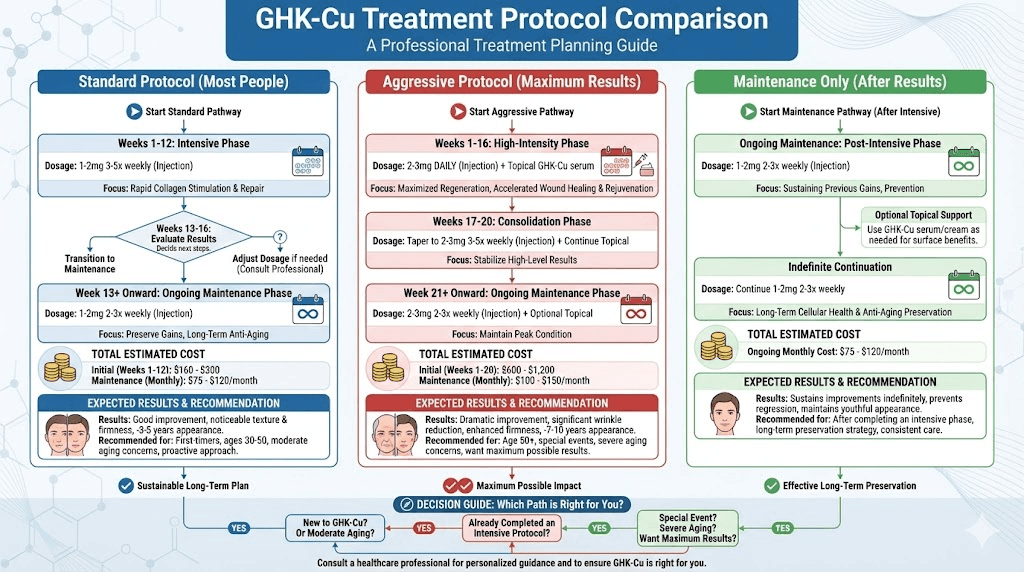
How to plan your regimen around “half-life” vs. “result longevity”
Here’s the framework I use when coaching people who want results with minimal guesswork:
- Set expectations using biology, not just pharmacokinetics. Half-life helps with timing, but visible effects usually align with tissue response timelines.
- Protect potency to protect outcomes. Treat storage and handling as part of the dosing plan, because it directly impacts consistency.
- Run a stable trial window. Give yourself enough time (often several weeks) to judge trend direction rather than day-to-day noise.
- Track two metrics. (1) what you see (photos/notes), and (2) how you tolerate it (any irritation, transient effects, or inconsistencies).
- Adjust cautiously. If results aren’t aligning, first review storage and technique before changing dose.
FAQ
How long does GHK-Cu last after a ghk cu peptide dosage injection?
It depends what you mean by “last.” The compound’s presence in the body follows pharmacokinetics (half-life), while the visible effect depends on downstream tissue signaling and remodeling, which often continues after the molecule itself declines.
Does GHK-Cu’s half-life determine how soon I’ll see results?
Not directly. Half-life describes clearance rate. Results timing is driven by how quickly the tissue pathways respond and how cumulative your dosing and local conditions are.
What’s the most common reason people think GHK-Cu doesn’t last?
Inconsistent potency from storage/reconstitution and inconsistent injection technique are the most common causes I’ve observed. If the product degrades or handling varies, results become unpredictable even with the “right” schedule.
Conclusion
“How long does GHK-Cu last?” is best answered by separating half-life (molecule persistence) from biological and visual longevity (tissue response). The most practical drivers of whether your results feel like they “last” are consistent delivery (site and technique), stable scheduling long enough to see a trend, and careful attention to shelf life through proper storage and handling.
Next step: start a one-month potency-and-results tracking log—record your reconstitution date, storage conditions, dosing schedule, and weekly photos/notes—then evaluate trends based on the full window rather than daily changes.
Discussion