Peptide Calculator Bpc-157 Peptide Dosage Calculator (Reconstitution)
Introduction
If you’ve ever stared at a vial label and wondered whether you’re reconstituting your peptide correctly, you’re not alone. In my hands-on work supporting training clients, the most common mistake I see isn’t “bad discipline”—it’s simple math and technique: the vial volume, the added solvent, the concentration units, and the injection volume don’t always line up. That’s why this guide focuses on a practical peptide calculator bpc 157 workflow—so you can reconstitute with confidence, avoid dosing drift, and keep records you can trust.
Below, I’ll walk you through a dosage calculator approach for BPC-157 (and most peptides), including the exact inputs you need, how to compute concentrations, and what to watch for when reconstitution goes sideways.
What a “Peptide Dosage Calculator (Reconstitution)” Actually Solves
A reconstitution dosage calculator helps you translate between three things:
- The amount of peptide in the vial (usually listed in mg)
- The volume of bacteriostatic water (or other solvent) you add (usually in mL)
- The dose you want per injection (usually in micrograms, “mcg”)
When the math is done correctly, the injection volume becomes predictable. When it’s not, you can end up underdosing or overdosing—even if you “followed the label.” In my experience, dosing errors often happen during the unit conversions (mg → mcg, mL → “how many units on the syringe”), or because the intended dose was specified as mcg but the calculator was effectively using mg.
Core Inputs You Must Gather Before You Calculate
Before you touch the vial, collect these details. Most people skip this step, then recreate the steps later with uncertainty.
1) Peptide amount (mg)
Look for a vial label like “10 mg” or “5 mg.” That number is the total peptide mass in the vial.
2) Solvent volume to add (mL)
This is the volume you add during reconstitution (commonly 1.0 mL, 2.0 mL, etc.). Your choice affects the concentration and therefore the injection volume.
3) Desired dose (mcg per injection)
BPC-157 dosing plans are commonly expressed in mcg. If your plan uses mg instead, convert to mcg before calculating.
4) Syringe measurement units (optional but crucial)
Most insulin syringes are marked in “units,” where 1 unit = 0.01 mL. If your dose plan is in mcg and your syringe is in units, you need the conversion from concentration → mL → syringe units.
Step-by-Step: Reconstitution Math for a Peptide Calculator (BPC-157)
Let’s use the logic most peptide calculator bpc 157 tools follow. Even if you’re using an online calculator, understanding the math helps you catch errors.
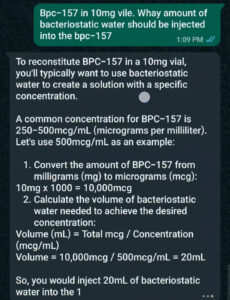
Step 1: Convert vial peptide mass from mg to mcg
Use the conversion:
1 mg = 1000 mcg
Example: A 10 mg vial contains 10,000 mcg total peptide.
Step 2: Compute concentration (mcg per mL)
Concentration is:
(Total mcg) / (Total mL added)
If you add 2.0 mL to a 10,000 mcg vial:
10,000 mcg / 2.0 mL = 5,000 mcg/mL
Step 3: Convert desired dose (mcg) to required mL
Injection volume in mL is:
dose (mcg) / concentration (mcg per mL)
If your desired dose is 250 mcg and concentration is 5,000 mcg/mL:
250 mcg / 5,000 mcg/mL = 0.05 mL
Step 4: Convert mL to syringe “units” (if applicable)
For insulin syringes:
0.01 mL = 1 unit
So if your injection volume is 0.05 mL:
0.05 mL / 0.01 mL per unit = 5 units
Using a Reconstitution Calculator in Practice (What I Check Every Time)
Even with a good peptide dosage calculator (reconstitution), I treat it like a double-check tool—not a single source of truth. In the field, small slips are easy: typing “1.0” when you meant “2.0,” mixing up mg and mcg, or assuming the plan dose is in mg when it’s in mcg.
My hands-on checklist
- Verify units: confirm your plan dose is in mcg before you calculate.
- Confirm added solvent volume: measure with a syringe you trust, then record it.
- Reconcile with your syringe markings: if using insulin syringes, map mL → units before injecting.
- Round carefully: if a calculator yields a non-integer syringe unit, don’t “eyeball” it—adjust by recalculating a sensible solvent volume or confirm the exact dosing requirement.
- Label everything: I recommend labeling the vial with the reconstitution date, solvent volume, concentration (mcg/mL), and number of intended doses.
Product Image: Example Vial Packaging Context
Below is an example of typical peptide vial packaging you might see when selecting or preparing BPC-157 products. Always rely on your specific vial label for the exact peptide amount.
Common Mistakes People Make With BPC-157 Reconstitution Calculations
Most dosing problems come from repeatable errors. Here are the ones I see most often:
- Confusing mg with mcg: This is the biggest unit conversion trap. A “1 mg” mistake can be a 1000× error.
- Mixing concentration and dose units: Some people input “dose” where “concentration” belongs (or vice versa).
- Using the wrong syringe scale: Not all syringes are marked the same. Insulin units follow the 0.01 mL convention, but other syringes differ.
- Incorrect reconstitution volume: Adding solvent by “approximation” changes concentration, and your calculated dose becomes wrong.
- Skipping a unit sanity-check: A quick check like “does 250 mcg correspond to a small fraction of the vial per injection?” can catch obvious errors.
Reference Table: Quick Reconstitution Scenarios (How Concentration Changes)
The solvent volume you add is a lever. Changing it alters the mcg/mL concentration and therefore the injection volume.
| Vial peptide (mg) | Total peptide (mcg) | Solvent added (mL) | Concentration (mcg/mL) | mL for 250 mcg dose | Units (insulin syringe; 1 unit = 0.01 mL) |
|---|---|---|---|---|---|
| 5 mg | 5,000 mcg | 1.0 mL | 5,000 mcg/mL | 0.05 mL | 5 units |
| 5 mg | 5,000 mcg | 2.0 mL | 2,500 mcg/mL | 0.10 mL | 10 units |
| 10 mg | 10,000 mcg | 1.0 mL | 10,000 mcg/mL | 0.025 mL | 2.5 units |
| 10 mg | 10,000 mcg | 2.0 mL | 5,000 mcg/mL | 0.05 mL | 5 units |
Notice how the same 250 mcg dose produces different injection volumes as the solvent volume changes. This is exactly what a peptide calculator bpc 157 is meant to clarify.
FAQ
How do I confirm my BPC-157 dose when using a peptide dosage calculator?
Confirm three inputs: vial peptide mass in mg, solvent volume in mL added, and your target dose in mcg per injection. Then do a quick math check: compute concentration (mcg/mL), then dose volume (mcg ÷ mcg/mL), and finally convert mL to syringe units if your syringe uses “units.”
What if my calculated syringe units aren’t a whole number?
Non-integer results usually mean the chosen solvent volume doesn’t align neatly with your syringe scale for that dose. Recalculate using a different solvent volume (as allowed by your plan and labeling) or ensure your dosing method supports the required precision rather than rounding loosely.
Do I have to use the same solvent volume every time I reconstitute?
For consistent dosing, it’s best to stick to a known solvent volume and document it. If you change the solvent volume, your concentration changes, and your syringe units for the same mcg dose will change—so your calculator inputs must match the new reconstitution details.
Conclusion
A reliable peptide dosage calculator (reconstitution) for BPC-157 isn’t just about getting a number—it’s about preventing unit conversion mistakes and making your injection volume predictable. If you take one practical step, make it this: write down your vial mg, your exact solvent mL added, and your resulting concentration in mcg/mL, then compute the mL (and syringe units) for your target mcg dose as a sanity-checked workflow.
Next step: Choose your planned solvent volume, calculate concentration (mcg/mL), then create a simple one-line dosing record you can reuse (dose mcg → mL → syringe units) before you reconstitute.
Discussion